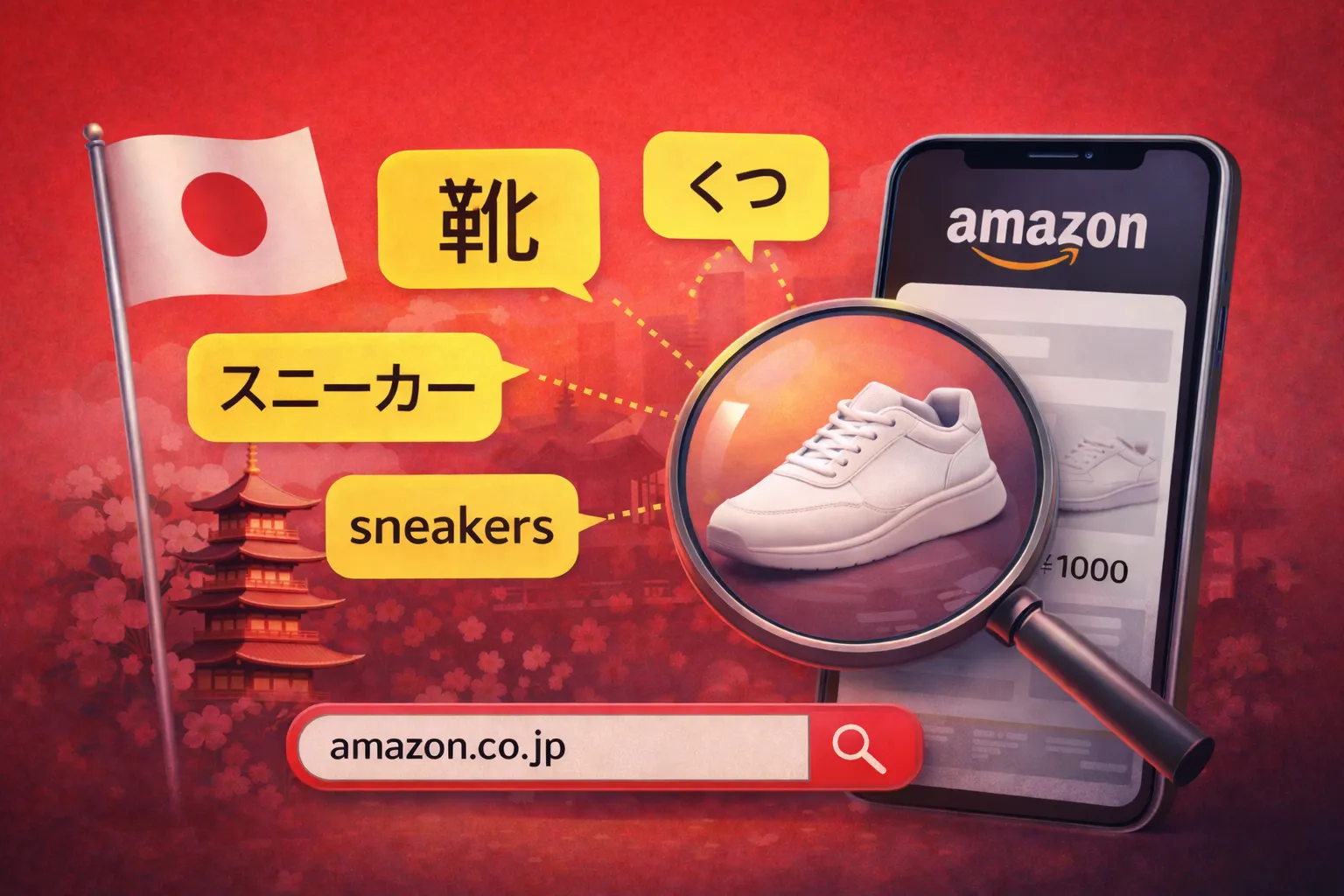
Expanding to Amazon Japan has changed. In the era of Rufus, Amazon's AI shopping assistant, the old rules of keyword stuffing are dead.
If you aren't optimizing for the four distinct Japanese writing systems—Hiragana, Katakana, Kanji, and Romaji—you are invisible to 75% of the market.
The Rufus Revolution: From Keywords to Intent
Rufus has shifted the landscape from "lexical matching" (exact words) to "semantic intent" (meaning). It doesn't just look for your keywords; it reasons through them to see if you are the right answer to a customer's question.
No spaces between words. Japanese text runs continuously. Where English clearly separates "kids mask" into two words, Japanese runs characters together. Only someone who understands the language—and how shoppers actually search—knows where one word ends and another begins. This affects how Amazon's algorithm parses and matches keywords.
Four writing scripts. Japanese people mix and match four different scripts in everyday use. The same word can be written multiple ways, and shoppers search using whichever version comes to mind. If you only optimize for one, you miss the others.
The Four Scripts You Need to Know
Hiragana (ひらがな)
Native Japanese script with ~50 characters. Curvy, flowing characters. Each character combines a consonant and vowel. Used for native Japanese words.
Katakana (カタカナ)
Script for foreign words. Sharp, angular characters. "Starbucks," "mask," "baby" are all written in Katakana because they are borrowed words.
Kanji (漢字)
Chinese-derived characters. Each character represents a whole word or concept. Reserved for traditional Japanese words with historical roots.
Romaji (ABC)
English alphabet. Japanese people recognize and search using English letters, especially for brand names and common foreign products.
Here is how to identify them: Hiragana characters are curvy and flowing. Katakana characters are sharp and angular. Kanji characters are complex pictographs with multiple strokes. Romaji is the English alphabet you already know.
Real Example: Kids Mask
Let's see how this works with a real product. "Kids mask" can be written four different ways in Japanese, and each version has different search volume.
Search Frequency Comparison
The Kanji version (子供マスク) has the lowest search frequency rank, meaning it is the most popular. That version should be in your title, as close to the front as possible. The other versions should be in your bullet points, backend keywords, and PPC campaigns.
If you only optimized for one version, you would miss three other streams of traffic. This is why Japanese keyword research requires 4x the effort of English, but also offers 4x the opportunity.
The Six-Figure Mistake
This is where brands hemorrhage money. Most use basic translation, but Rufus needs Noun Phrase Optimization (NPO) to understand your product's purpose across all four scripts.
- Basic translation gives you one script—you miss 75% of searches
- Keyword stuffing worked in 2020—Rufus now penalizes it
- Machine translation misses semantic context that AI demands
- Single-script optimization means the algorithm "scrambles" your data
- No native insight into how Japanese shoppers actually phrase their searches
Without a strategy that maps your brand into Amazon's new AI knowledge graph—built on native understanding of how Japanese shoppers search for products—the algorithm will burn your ad budget on ghost traffic and irrelevant matches.
The Research Process
Start with Google Translate (Extended)
Use Google Translate's extended view (translate.google.com/?sl=en&tl=ja&op=translate) which shows multiple translations with frequency indicators. This gives you all script variations, not just the most common one.
Verify on Amazon.co.jp
Copy each translation and paste it into Amazon Japan's search bar. Visual confirmation that the results match your product category. If you see completely unrelated products, that translation is wrong.
Reverse-Translate to Confirm
Translate the Japanese back to English. Similar-sounding words can have completely different meanings. A two-step verification (English → Japanese → English) catches errors before they reach your listing.
Check Brand Analytics
If you have Brand Registry, use Brand Analytics to find the search frequency rank for each variation. The lower the number, the more popular the keyword. This tells you which version goes in your title.
Build Your Keyword Pool
Create a spreadsheet with all four versions of each seed keyword. Include search frequency rank where available. This becomes the foundation for your listing optimization and PPC strategy.
The Hiragana Trap
There is a critical warning about Hiragana that most sellers learn the hard way.
Avoid Broad Match for 2-Character Hiragana Words
Amazon's algorithm treats each Hiragana character as a potential separate word. A two-character word like まぐ (mug) can match ぐま (bear) because the algorithm rearranges characters. Use Phrase Match or Exact Match for Hiragana keywords to prevent garbage matches.
This happens because Japanese has no spaces. The algorithm cannot reliably determine word boundaries with Hiragana, so it tries different combinations. Katakana does not have this problem because it is reserved for foreign words, and the algorithm handles it differently.
If you see strange search terms in your reports, keywords that seem completely unrelated to your product, check if they are Hiragana rearrangements. The fix is switching from Broad Match to Phrase Match.
PPC Strategy for Japan
| Script Type | Match Type | Notes |
|---|---|---|
| Katakana | Broad, Phrase, or Exact | Safe for all match types. Foreign words are handled cleanly. |
| Kanji | Phrase or Exact | Complex characters. Phrase match is generally safe. |
| Hiragana | Phrase or Exact Only | Never use Broad match. Character rearrangement causes garbage matches. |
| Romaji/English | Broad, Phrase, or Exact | Behaves like standard English keywords. |
Campaign Structure Tip
Create separate ad groups or campaigns for each script type. This keeps your data clean and makes it easier to identify which script variations are performing. Do not mix Hiragana and Katakana keywords in the same campaign.
Best Practices Summary
- Research all four scripts. Every seed keyword needs Hiragana, Katakana, Kanji (where applicable), and Romaji variations.
- Prioritize by search frequency. Use Brand Analytics to find the most popular version. That goes in your title.
- Avoid Broad Match for Hiragana. The character rearrangement problem will waste your ad spend.
- Include English keywords. Japanese shoppers search in English, especially for foreign products and brand names.
- Keep campaigns small. No more than 10 keywords per campaign. Budget distributes evenly, and data stays clean.
- Use Auto campaigns for discovery. When you do not know the language, let Amazon's algorithm find keywords for you. Harvest winners into manual campaigns.
- Verify everything twice. English to Japanese, then Japanese back to English. Similar-sounding words can mean completely different things.
Working with Translators
If you just hand your English listing to a translator, you will get a grammatically correct translation that is not optimized for Amazon. The translation might read beautifully but miss the keywords that actually drive traffic.
Before translation, do your keyword research. Identify the most popular script variations for your main keywords. Then tell your translator: "I need these specific keywords included, in this priority order, using these exact scripts."
A good translator will integrate the keywords naturally. But they cannot do keyword research for you. That is a separate skill set that requires understanding Amazon's algorithm, Brand Analytics, and search behavior.
Full Webinar: Amazon Japan Keyword Research
Ritu Java, CEO of PPC Ninja, walks through the complete process with live examples, including how to use Google Translate's extended features and Brand Analytics for Japanese keyword discovery.
Noun Phrase Optimization: The Rufus-Ready Solution
NPO is the technical architecture that Rufus and the Japanese shopper both demand. It's not translation—it's building the semantic structure that tells the AI exactly what your product does, who it's for, and why it matters.
This means:
- Full four-script coverage so you capture every search variation
- Semantic entity mapping that aligns with how Rufus reasons
- Native understanding of how Japanese shoppers phrase their searches
- Intent-based keyword architecture across the customer journey
- AI-optimized backend structure that feeds the knowledge graph
We are the experts in Japanese advertising, localization, and listing creation. We don't just translate; we build the technical architecture that Rufus and the Japanese shopper both demand.
Ready to Lead in Japan?
Build your 100% search coverage roadmap and stop leaving 75% of your traffic to chance.
Book a Japan Strategy Call