
A sales funnel illustrates the journey a potential customer goes through before making a purchase. On Amazon, that journey spans multiple touchpoints, and Amazon has given us ad types designed for each stage.
The problem? Most sellers only run lower-funnel ads. They focus exclusively on Sponsored Products with exact match keywords, chasing immediate ROAS. That works until it stops working, which usually happens when competitors enter the market, CPCs rise, and there is no brand recognition to fall back on.
A full funnel strategy means using different ad types for different purposes: some to build awareness, others to drive consideration, and the most targeted ones to close the sale.
The Three Stages of the Funnel
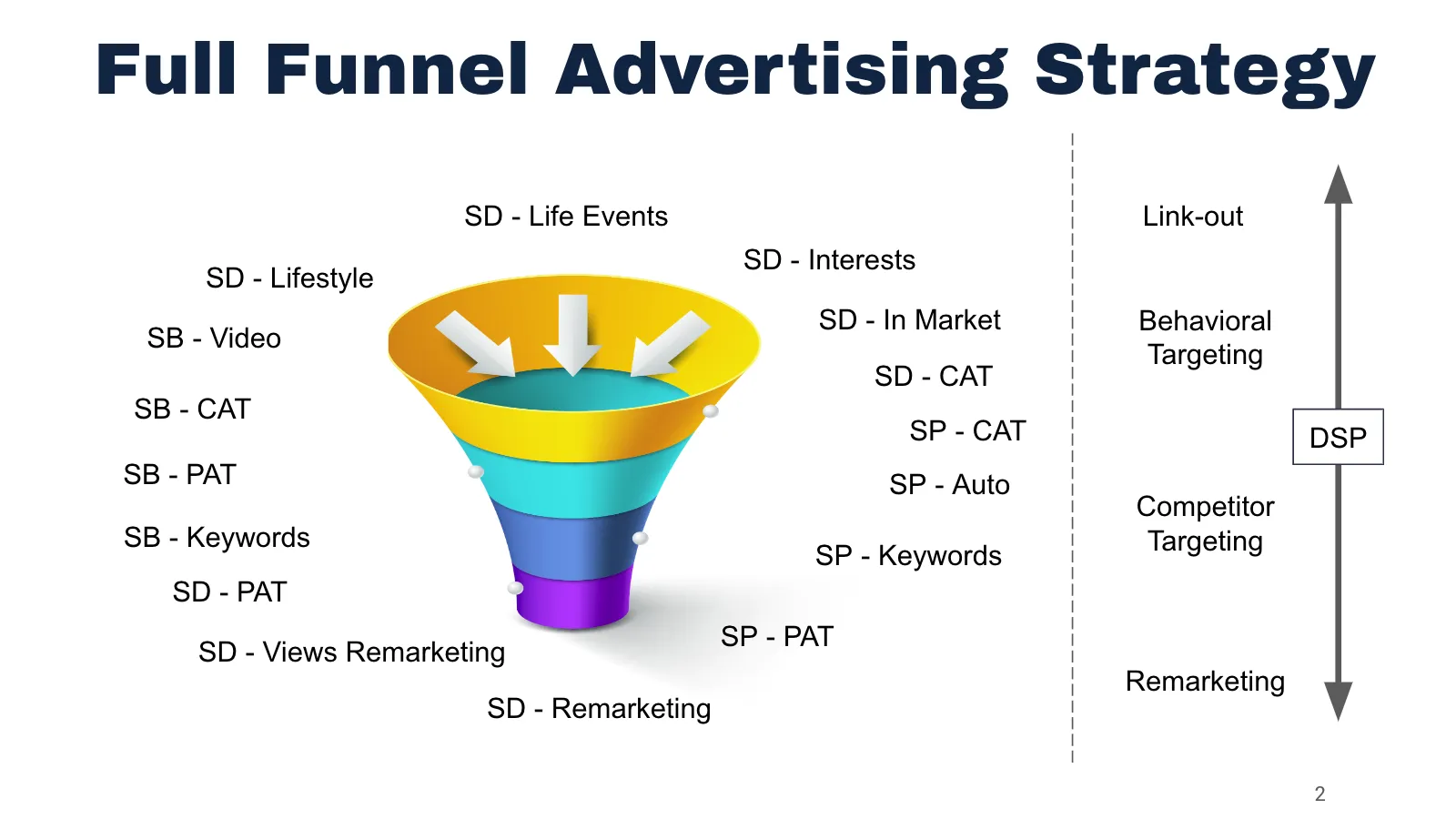
Top of Funnel: Awareness
Upper funnel ads are not responding to a search query. They are shown based on shopper behavior, life events, or interests. Someone becomes a new parent. Someone is planning a graduation party. Someone has been browsing kitchen products.
Sponsored Display gives you access to these audiences through:
- Life Events: New parents, movers, recent graduates
- Interests: Fitness enthusiasts, pet owners, gamers
- Lifestyle: Health-conscious shoppers, frequent travelers
- In-Market: Actively researching a category
Set Expectations Correctly
Upper funnel ads will not deliver the ROAS you see from keyword targeting. You are introducing your brand to people who are not actively searching. This is brand building, not direct response. Budget accordingly.
DSP extends this further with link-out campaigns that can drive traffic to your website, YouTube channel, or other off-Amazon properties. This is how you build brand equity outside Amazon's ecosystem.
Middle of Funnel: Consideration
Consideration-stage ads target people already shopping in your category. They may not know your brand exists, but they are looking at products similar to yours.
Category targeting is the key tool here. Your ad appears near products in your category, capturing shoppers who have already committed to buying something in this space.
| Ad Type | Best For | Expected ROAS |
|---|---|---|
| SD Category Targeting | Appearing on competitor detail pages | Moderate |
| SP Category Targeting | Showing in category carousels | Moderate |
| SB Category Targeting | Brand visibility across category | Lower |
| Broad Keywords | Catching browsing shoppers | Variable |
Broad keywords like "kitchen" or "pet supplies" also function as middle-funnel targeting. The searcher has not specified exactly what they want. They are browsing, considering options.
Bottom of Funnel: Conversion
This is where most Amazon advertisers live. The customer knows what they want. They have typed a specific query. Your job is to appear and convert.
Keyword Targeting
Long-tail exact match keywords are the precision tool. "Stainless steel chef knife 8 inch" signals high purchase intent. These keywords are expensive because they convert, but they should form the backbone of your lower-funnel strategy.
Product Targeting (Contextual Targeting)
Your ad appears on competitor product detail pages. This is powerful because you are catching a pre-qualified lead. Your competitor already did the work of getting them to the page. Your ad offers an alternative at the moment of decision.
Product Targeting Advantage
Product detail pages have over 100 ad placements in carousels. Competition is often lower than search placements. CPCs can be significantly cheaper while still reaching high-intent shoppers.
Remarketing
The most underutilized lower-funnel tactic. Shoppers who visited your page but did not buy. Shoppers who purchased from you before and might need a refill.
The statistic is clear: customers are roughly nine times more likely to buy from a brand they have purchased from before. But if you are not remarketing, you are not reminding them you exist.
Sponsored Display remarketing options:
- Views Remarketing: People who viewed your products (7, 14, 30, 60, 90 days)
- Purchases Remarketing: Previous customers (7 to 365 days)
DSP takes this further with precise windows. If you sell a supplement that lasts 30 days, you can target customers at exactly the 25-30 day mark when they are running low.
Why Most Sellers Get This Wrong
The natural instinct is to chase ROAS. Run only the ads that directly convert. That works until:
- CPCs rise as competitors enter
- Your brand has no recognition, so even top positions do not convert
- Someone else has been running upper-funnel ads and is now top-of-mind
The brands that win long-term invest in the full funnel. They accept that upper-funnel ads have lower direct ROAS because those ads build the brand equity that makes lower-funnel ads work better.
Brand Defense Cuts Across the Funnel
One strategy applies to every stage: defending your brand. If someone searches your brand name and finds a competitor, you have lost a customer you already earned.
Brand defense means running branded keyword campaigns, targeting your own ASINs with Sponsored Display, and making sure that wherever your brand name appears, you own that real estate.
Check Your Ego at the Door
Most Amazon sellers are micro-brands. Customers will not remember your name unless you consistently appear in front of them. Do not assume brand loyalty exists. Earn it through consistent visibility.
Practical Implementation
If You Are Just Starting
- Master lower-funnel first: Sponsored Products with exact keywords
- Add product targeting for competitor detail pages
- Implement remarketing for visitors and past purchasers
- Run branded keyword defense
If You Are Ready to Scale
- Add category targeting across SP, SB, and SD
- Test Sponsored Brands Video for high-visibility placements
- Explore Sponsored Display audiences (in-market, interests)
- Consider DSP for precise remarketing windows and off-Amazon reach
Budget Allocation Guidelines
| Funnel Stage | New Brand | Established Brand |
|---|---|---|
| Lower Funnel (Conversion) | 70-80% | 50-60% |
| Middle Funnel (Consideration) | 15-25% | 25-30% |
| Upper Funnel (Awareness) | 5-10% | 15-20% |
Deep Dive: 10 Ways to Grow Your Brand with PPC
Ritu Java, CEO of PPC Ninja, breaks down underutilized Amazon advertising strategies including full-funnel implementation in this interview with Norm Farrar.
The Bottom Line
A full funnel strategy is not about abandoning ROAS. It is about understanding that different ad types serve different purposes. Lower-funnel ads close sales. Upper-funnel ads build the brand recognition that makes those sales possible.
Most of your budget will still go to conversion-focused advertising. That is correct. But a portion should always be expanding the funnel, bringing new customers into awareness who will eventually become the conversions you measure.
The brands that dominate Amazon in 2026 are not the ones with the best individual ROAS on a single campaign. They are the ones with a coordinated strategy across the entire customer journey.
Ready to Build Your Full Funnel Strategy?
PPC Ninja helps brands implement coordinated advertising strategies that drive both immediate sales and long-term brand growth.
Book a Strategy Call