
While several people are still debating whether Rufus matters at all, the algorithm is already reshaping how shoppers discover products. And it runs on completely different fuel than the one you have spent years mastering.
Here is the mental model most people have not mapped out yet: two flywheels, running simultaneously, feeding each other.
Two Flywheels, One Destination
Flywheel 1: A9
Traditional keyword search. A shopper types a query, A9 matches keywords, you get the click, the sale boosts your keyword ranking, and the wheel spins faster. This is the engine we have all been tuning for years.
Flywheel 2: Rufus
Conversational AI search. A shopper asks something like "what's the best water bottle for hiking that keeps drinks cold all day?" Rufus does not match keywords. It reads your listing, your reviews, your Q&A, your brand story. It decides if you are semantically relevant. If it recommends you, the sale feeds back into your relevance score, and that wheel spins faster too.
Same destination. Two very different roads.
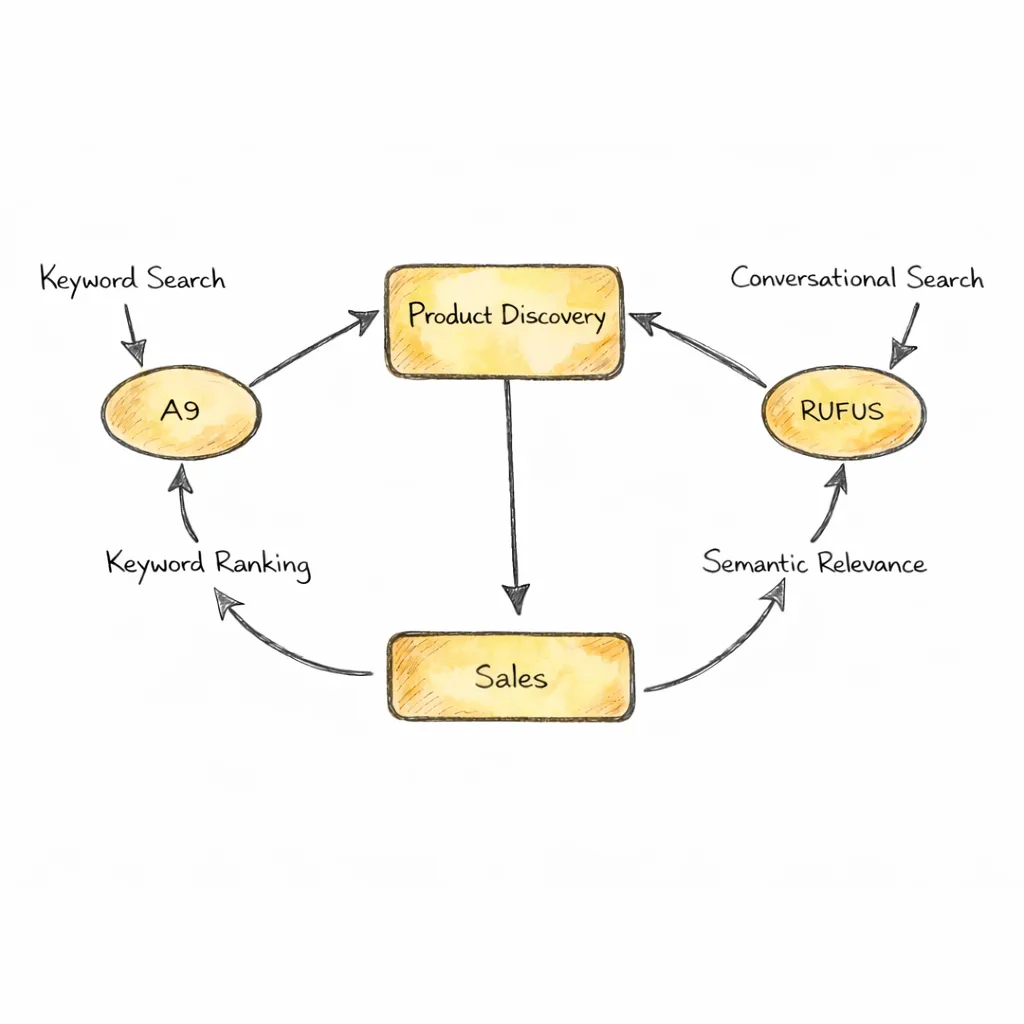
The interesting part? These flywheels are not independent. They share a center of gravity: product discovery. A sale from either engine fuels both. But the inputs are completely different.
What Dual-Flywheel Optimization Looks Like
- Your listings still need strong keyword architecture for A9. This has not changed. Keyword relevance remains the foundation of traditional search ranking.
- But they also need natural, conversational language that Rufus can parse and recommend. Rufus reads for meaning, not keyword density. It pulls from your entire product narrative.
- Reviews and Q&A sections now directly influence AI-driven discovery. These are no longer just social proof. They are input data for how Rufus understands and recommends your product.
- Structured product narratives matter as much as keyword density. A+ Content, brand stories, and well-written bullets give Rufus the semantic context it needs to match conversational queries.
The Key Distinction
The old playbook is not dead. It is just half the picture now. Keyword density still powers Flywheel 1. But Flywheel 2 does not care how many times you said "stainless steel." It cares whether your product actually answers the shopper's question.
Why Both Flywheels Feed Each Other
A sale driven by a Rufus recommendation does not just boost your AI relevance score. It also improves your organic keyword ranking. Conversely, a strong keyword-driven organic position means more visibility, more sales velocity, and more data for Rufus to evaluate.
When both flywheels are spinning, each sale compounds into the next. That is not just optimization. That is a moat. And the metric that powers it all is conversion rate. Every conversion feeds both wheels simultaneously.
Where Most Sellers Get Stuck
Most sellers are still operating on a single flywheel. Their entire strategy is built around A9: keyword research, bid optimization, search term harvesting, and placement modifiers. That still works. But it leaves the Rufus flywheel untouched.
The problem is that Rufus-driven discovery is growing. More than 250 million customers have used Rufus in the past year, and Amazon has now renamed it Alexa for Shopping in the US. Amazon is already building ad placements inside Rufus conversations. Ignoring that flywheel means giving up a growing share of discovery to competitors who are not ignoring it.
How to Start Spinning Both Wheels
For Flywheel 1 (A9)
Continue doing what works. Strong keyword architecture in titles and bullets. Backend search terms covering your semantic territory. Bid strategies aligned with placement performance. This is still the foundation.
For Flywheel 2 (Rufus)
Shift your content mindset. Write listings that answer questions, not just match keywords. Seed your Q&A section with detailed, conversational responses. Build A+ Content that tells a product story, not just a feature list. Ensure your images communicate benefits that AI can parse.
For Both
Monitor where your sales are coming from. As Sponsored Products Prompts roll out, you will start seeing which conversational queries drive revenue. Use that data to inform both your keyword strategy and your content strategy.
The sellers who figure out how to spin both wheels at the same time are building a compounding advantage that gets harder to catch every month. The question is which flywheel is getting most of your attention right now.
At PPC Ninja, this is exactly where we live. Right at the intersection of AI-ready ads and AI-ready content. We help sellers build ad strategies that power keyword rankings and craft content that earns Rufus recommendations. Because when both flywheels are spinning, that is when the real compounding begins.
Ready to Spin Both Flywheels?
We build Amazon strategies that optimize for A9 and Rufus simultaneously. Let's talk about your account.
Book a Strategy Call